Landgoed den Treek
On June 21, 2025, four participating artists (Niels Albers, Koen Moonen, Cathérine Schoenmakers and Liselore Frowijn) concluded their residency (February – June 2025) on the invitation of Stichting den Den at the Den Treek estate in Leusden, the Netherlands, with a public gathering. Marking the summer solstice—the longest day of the year—they invited visitors into a shared reflection on how they have lived in the forest over the preceding months, accompanied by a constellation of more-than-human beings, including the wolf. Through a ritual inspired by Scandinavian Midsummer traditions, they celebrated the sun and collective being.
At sunset, by the water, the gathering paused to contemplate life in relationality with nature, echoing ancient practices in which the sun was honoured as a powerful deity and the rhythms of life were inseparable from the land.[1] The Christianization of Europe did not erase such pagan festivals; rather, it absorbed and rebranded them within a patriarchal religious framework. Midsummer, long associated with water and fertility, was assimilated into the feast of Saint John the Baptist. Similarly, Christmas—the celebration of Christ’s birth—was strategically positioned near the winter solstice to co-opt the symbolic return of the light, a motif central to earlier cosmologies.[2] These historical appropriations illustrate how dominant systems have long attempted to contain or recast embodied, nature-based forms of knowing and celebration.
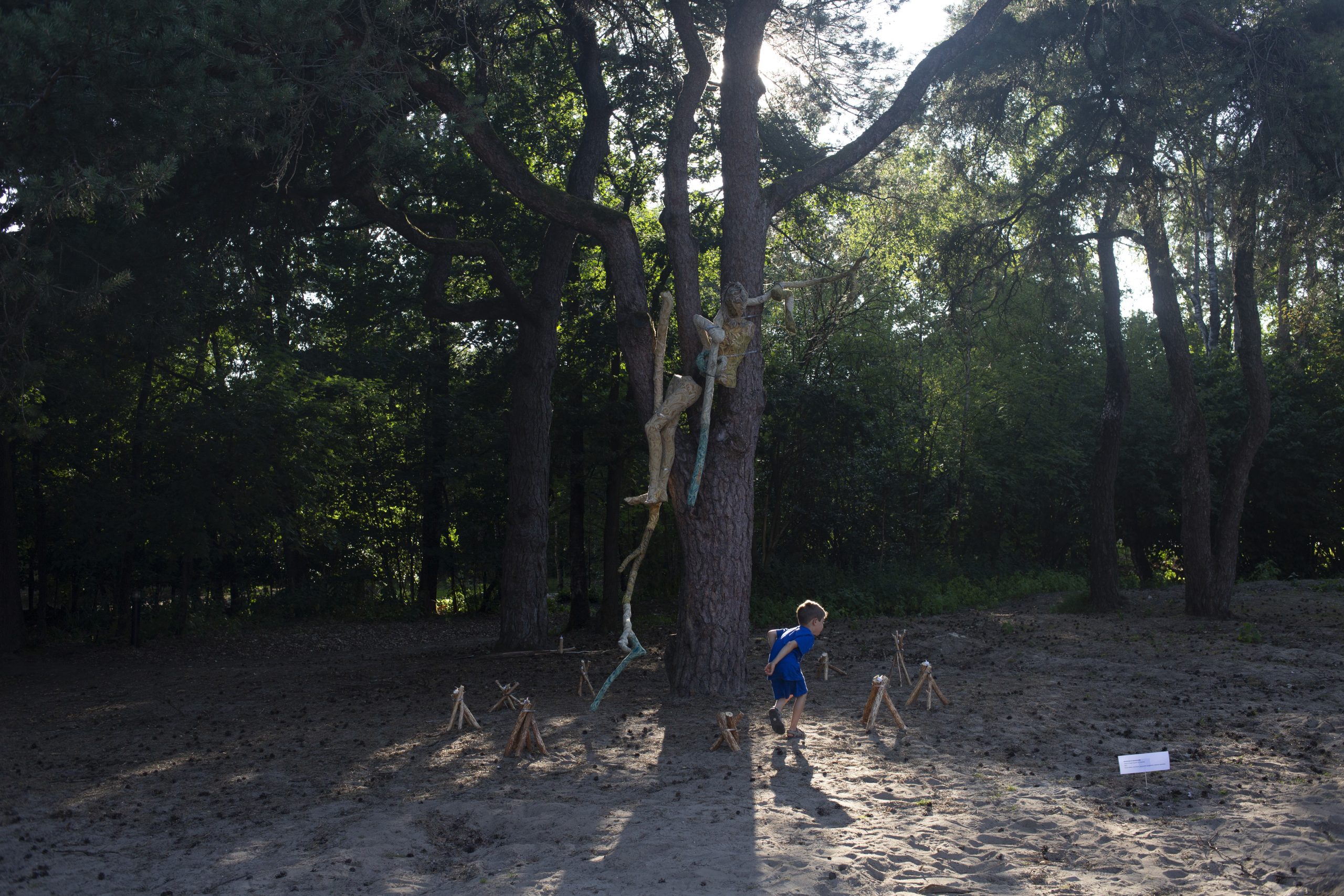
During her stay, Liselore was struck by the arrival of wolves in the area and the fear that this evoked. This reminded her of witch hunts that also took place in this forest in the 16th century. In her (textile sculpture) work, she draws a comparison between the exclusion of ‘the other’ then and now, and she searches for ways to live together with people and more-than-humans (animals) in a changing world. It is within this context that artist Liselore Frowijn developed an installation of textile sculptures, collages, a soundscape and an essay. This body of work emphasises the relations between nature, body, ritual and power, with attention to the intertwining of human and more-than-human actors, gender politics, and the historical oppression of the ‘other’. At the heart of this gesture is a particular pine tree opposite the wooden house where Frowijn lived during the residency. Here, a textile sculpture, Hagazusah in Widdershins (2025), appears as in a temple to dance with the tree, enacting a ritual of interspecies intimacy. Visitors can enter this sanctuary and listen to the soundscape Air Spirits (2025) with stories from these woods, narrated by both humans and more-than-humans.
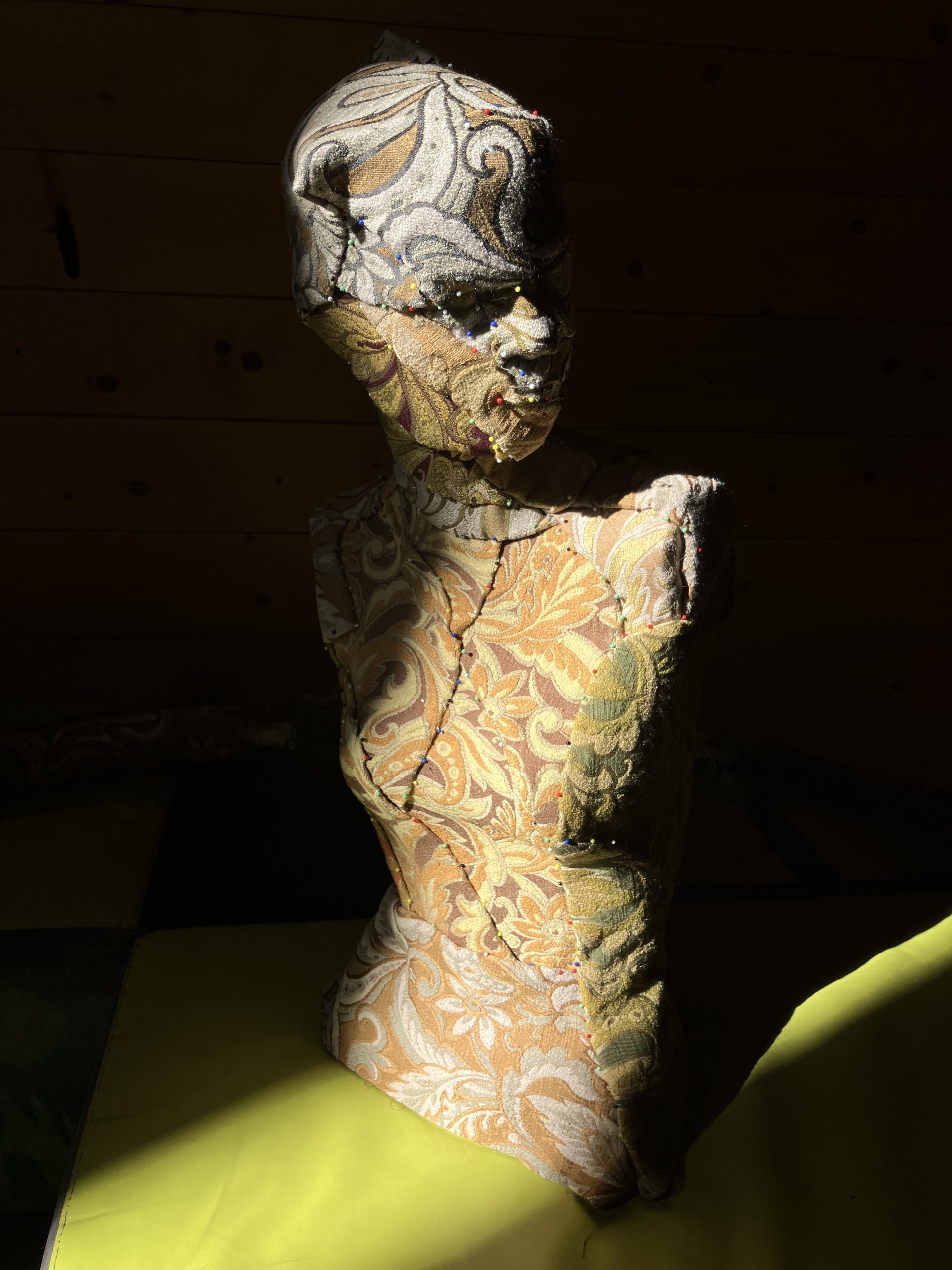
This textile sculpture is developed by gathering branches from the forest, selected for their unruly, organic forms, which Frowijn embroidered around them with jacquard-woven textiles featuring leaf motifs. These fabrics, entangled with fragmented representations of human anatomy, create a hybrid body in which vegetal and human forms converge. Although the leaf patterns on the jacquard fabrics are machine-woven—and thus artificial and industrial—they visually blend with the surrounding nature in both colour and form, dissolving into the forest as a lizard in camouflage. Through the act of embroidering them onto branches, the textiles adopt the contours of the natural world, while the wood itself is abstracted and estranged from its ecological origins. This ongoing exchange between textile and tree results in a hybrid, fabricated body—one that simultaneously merges with the landscape and signals a form of embodied otherness. These sculptures do not merely inhabit the forest; they intervene in it, staging a choreography of entanglement. The jacquard textiles themselves, originating from a now-defunct Italian upholstery textile factory, embody both the mechanised repetition of industrial production and the residual aura of premodern ornamentation.
Frowijn’s use of these materials continues the research she initiated during an earlier residency at textile hub Lottozero in Prato, Italy, where she was invited to engage with this archival material to examine the commodification of the (particularly female) body. The results of that investigation are currently exhibited at Lottozero’s Kunsthalle, curated by Alessandra Tempesti, within a broader discourse on body politics and gendered materialities. The body of work developed in Leusden forms a continuation of the dialogue that started in Prato, in line with feminist scholar Silvia Federici, who states in her book Caliban and the Witch how witch hunts led to women being restricted to bodies serving unpaid reproductive labour, with “the human body [as] the first machine invented by capitalism,” following the demands of an emerging capitalist movement.[3]
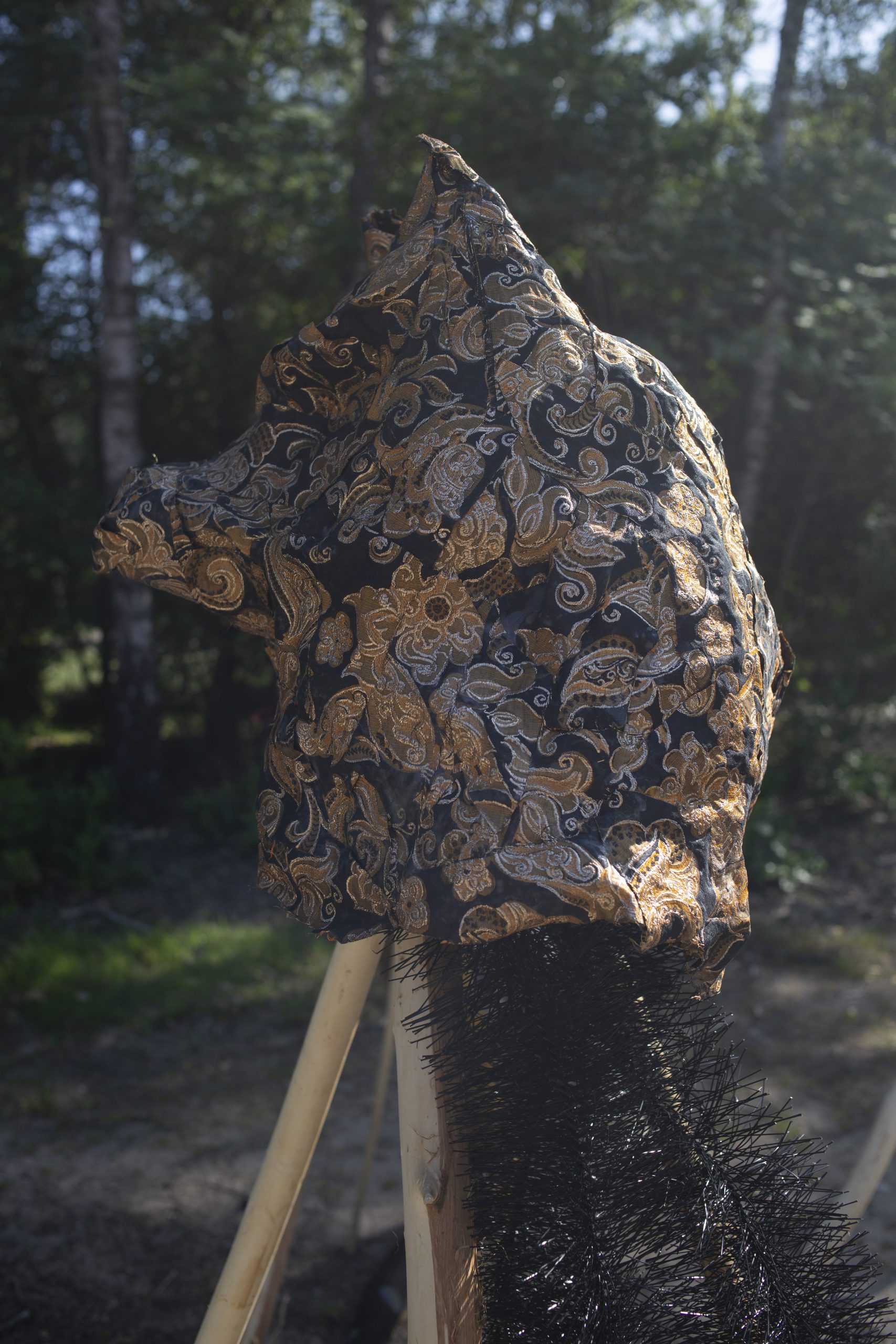
A few meters closer to the house, one finds a pathway of Hybrides (2025): paper-cut collages with uncanny human figures morphing into insects and other creatures from the woods, carried by a collection of branches carved by goats. Visitors are invited to walk down the path of pinecones to see the collages. In front of this path, one finds its gatekeepers: two sculpted wolf heads made of jacquard fabric-mâché, Romulus & Remus (2025), named after the mythical founders of Rome, who, according to legend, were suckled by a she-wolf. Even though the wolf returned to Den Treek, Frowijn has not seen the animal herself. Through these sculptures, Frowijn honours the enigmatic creature in an imaginary way, that, much like in the past, once again claims a place within a human-dominated landscape. In this ecofeminist reimagining, the wolf serves as a metaphor for resistance, kinship, and the potential for coexistence within a shared ecological fabric, where human and more-than-human lives are fundamentally entangled.
[1] Koomen, Het ijzige zaad van de duivel, 51-55.
[2] Koomen, Het ijzige zaad van de duivel, 76.
[3] Federici, Caliban and the Witch, 146.
Literature:
Federici, Silvia. Caliban and the Witch. First edition. Brooklyn, NY: Autonomedia, 2004.
Koomen, Martin. Het ijzige zaad van de duivel: geschiedenis van heksen en demonen. Amsterdam: Wetenschappelijke Uitgeverij, 1973.
Photography by Io Cooman